
Opinion: Whose Will Be Done? Examining Undue Influence in Probate Matters
As part of our Contract Law series, Raising the Bar presents our Opinion Article on Contract Law, presenting arguments for why the presumption of undue influence should be adopted in probate matters.


In this Opinion Article, find out…
How do the different classes of undue influence apply?
How does undue influence currently manifest in probate matters?
Should we adopt the presumption of undue influence in probate matters?
Unfortunate as they may be, inheritance disputes over family fortunes are as common as they are chaotic. In a whirlwind of accusations, one stands out as a tension point with potential legal implications — did someone force Grandpa to write this will?
In contract law, undue influence is deemed to be a vitiating factor — an element that can turn a contract, or in this case Grandpa’s will, voidable. Yet, it is exceedingly difficult to prove undue influence in probate matters, especially since the testator is no longer alive to testify if he was pressured into drafting his will in a certain manner.
Still, in an effort to better protect the final wishes of the deceased, we posit that a partial adoption of the presumption of undue influence should be considered for probate matters.
What Is Undue Influence, And Why Does It Matter?
According to Halsbury’s Laws of England, undue influence occurs when a stronger party pressures a weaker party into making decisions they would not have otherwise made.
The stronger party tends to use unfair or improper conduct to influence the weaker party’s decisions, and such decisions typically involve the weaker party entering into a transaction that gives the stronger party an unfair advantage.
The Two Classes of the Law of Undue Influence
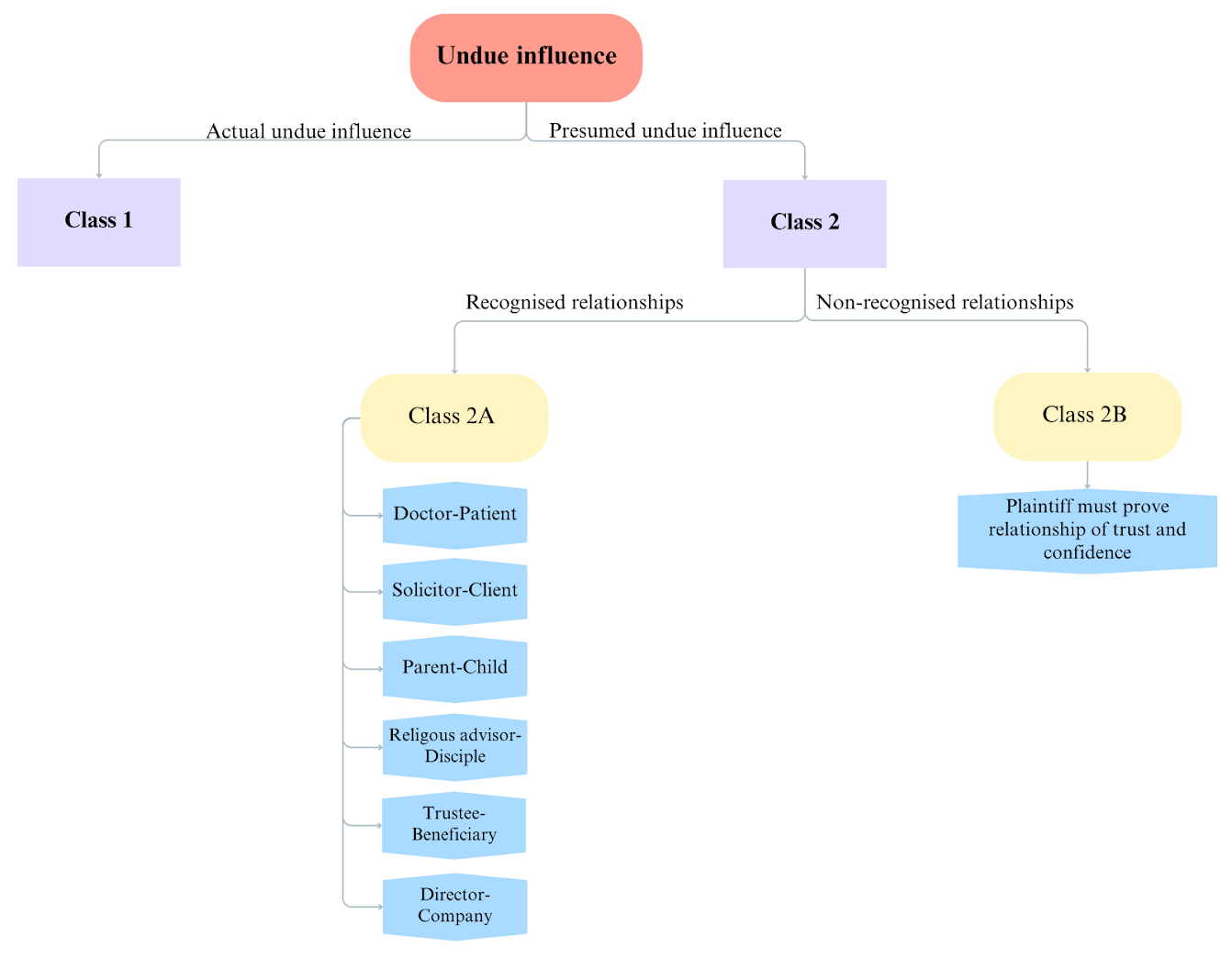
The law of undue influence can be split into two classes: Class 1 and Class 2.
In BOM v BOK and another appeal [2018] SGCA 83, the Court of Appeal established the framework for undue influence at [101], as summarised below:
Class 1 undue influence refers to actual undue influence, where the undue influence can be proven in a direct manner. To do this, the plaintiff has to demonstrate that:
The defendant had the capacity to influence him or her;
The influence was exercised;
The said exercise of influence was undue; and
The said exercise of influence brought about the transaction.
Class 2 undue influence refers to presumed undue influence, where the plaintiff need not prove actual undue influence. However, the plaintiff must first prove:
There was a relationship of trust and confidence between parties;
The relationship was such that it could be presumed that the defendant abused the claimant’s trust and confidence in influencing the claimant to enter into the transaction in question; and
The transaction was one that cannot be reasonably accounted for within the relationship of the parties.
Class 2 undue influence is further divided into Class 2A and Class 2B undue influence.
Class 2A undue influence refers to relationships that the law irrefutably presumes to give rise to a relationship of trust and confidence, which include Parent-Child, Doctor-Patient, Solicitor-Client, Trustee-Beneficiary, Director-Company, and Religious Advisor-Disciple relationships.
Class 2B undue influence constitutes all other relationships, where the plaintiff must first prove that there is a relationship of trust and confidence.
How Does Undue Influence Affect Probate Matters?
Broadly, probate law concerns the distribution of a deceased’s properties and assets. The scope of probate law covers areas such as the execution of wills, and the legal recognition of an individual as an executor of the deceased’s property.
However, in Singaporean law, undue influence in probate law is deemed to be the same as coercion.
This was established by Judicial Commissioner Tan Puay Boon in ULV v ULW [2019] SGHCF 2, who cited Theobald on Wills (18th e.d.) at para 3-032.
Further, in testamentary matters, undue influence cannot be presumed as set out in Rajaratnam Kumar (alias Rajaratnam Vairamuthu) v Estate of Rajaratnam Saravana Muthu (deceased) and another and another [2010] SGHC 164 (“Rajaratnam”) at [65].
Citing Hall v Hall (1868) LR 1 P&D 481, Rajaratnam at [66] establishes that undue influence in the probate context refers to coercion — it must be shown that the party accused of undue influence dominated the testator to such an extent that the their independence was so undermined that the testator executed the will.
Reasons Behind the Classification of Undue Influence as Coercion
The rationale for the lack of distinction between undue influence and coercion in probate matters would be the need for a careful balancing act between protecting the testator’s original intentions, and not opening the floodgates for unwarranted contests of the will’s validity.
First, there are unique financial and material incentives for benefactors to challenge wills that disproportionately benefit others over them. Second, close familial members wield the highest potential for undue influence, considering the personal nature of wills. However, the Courts wanted to avoid unintentionally discouraging family members from showing care to the testator for fear of accusations of undue influence.
Comparatively, a parent living alone with a child that takes care of them could become grounds for Class 2 undue influence simply due to the elderly parent’s vulnerability and social reliance on the child; pushing the child into a difficult circumstance of gathering evidence that undue influence had not taken place.
UWF and another v UWH and another [2020] SGHCF 22 at [237] explained that as testators, parents have full autonomy over their personal assets and are entitled to allocate their assets as they see fit.
Unless it can be shown that the will is a result of undue influence, the parents’ wishes have to be respected.
As such, critics of the adoption of Class 2 undue influence posit that the highly private and intimate nature of probate law would potentially lead to an overwhelming increase in unwarranted challenges, ultimately undercutting a parent’s autonomy over their last wishes.
Why Should Presumed Undue Influence Still Be Adopted?
Indeed, for a long time case law and academic authorities have strongly indicated the test for undue influence in probate matters is that of coercion alone. Traditionally, in countries using the common law system, undue influence cannot be assumed in the testamentary context.
However, in some common law countries — specifically Canada — the tide has begun to change. The Wills, Estate and Succession Act, introduced and passed in the Parliament of Canada in 2009, included new provisions regarding probate matters. In particular, Section 52 of the Act created a presumption of undue influence for probate matters. In light of this, we believe that it is time for Singapore to review its stance on the adoption of presumed undue influence.
Shifting the Burden of Proof
With the adoption of presumed undue influence in the testamentary context, testators can potentially receive better protections, especially due to the shift in the burden of proof that follows. Currently, with coercion as the only test for undue influence, the burden of proof is on the party alleging undue influence. This is affirmed by Rajaratnam at [65], citing Boyse v Rossborough [1857] 6 HLC 2 at [49].
Yet in the testamentary context, this burden of proof is particularly high for two reasons. First, there is the obvious problem that the testator is no longer alive to testify. Second, the “influencer” would likely have exerted their influence on the testator in private, making proving coercion difficult.
The high burden of proof is affirmed in Schrader v Schrader [2013] EWHC 466 (Ch), where difficulties in proving arose due to the circumstantial nature of the evidence:
“It will be a common feature of a large number of undue influence cases that there is no direct evidence of the application of influence. It is of the nature of undue influence that it goes when no-one is looking. That does not stop its being proved. The proof has to come, if at all from more circumstantial evidence.”
Further, the party alleging undue influence must also prove that the only hypothesis consistent with the facts is that the testator was coerced into creating the will.
This was established in Boyse v Rossborough [1857] 6 HLC 2:
“It is not sufficient to show that the circumstances attending its execution are consistent with the hypothesis of its having been obtained by undue influence. It must be shown that they are inconsistent with a contrary hypothesis.”
With the introduction of a presumption of undue influence, the burden of proof is shifted to the party defending the validity of the will instead, making it easier to challenge wills that may not reflect the testator’s true intentions.
Protecting Vulnerable Testators
Further, the protection of vulnerable testators is better ensured, by allowing courts to address more subtle forms of manipulation that fall short of the overt coercion required under Class 1 undue influence.
Such was the case in Hsu Ann Mei Amy (personal representative of the estate of Hwang Cheng Tsu Hsu, deceased) v Oversea-Chinese Banking Corp Ltd [2011] SGCA 3.
In this case, the daughter — the sole caretaker of her mother with dementia — had attempted to influence her mother into opening a joint account with her, and transferring all of her mother’s assets into the account.
By recognising the reality of diverse and complex family relationships, courts are able to guard more effectively against opportunistic behaviour by those in positions of trust or dominance.
Criticisms of a Full Adoption of Presumed Undue Influence
Admittedly, there are concerns with the complete adoption of presumed undue influence that hold weight.
For one, it is worth noting the personal nature of wills, and the need to respect the wishes of the testator regardless of the fairness of the will. A presumption of undue influence requires the judiciary to evaluate wills based on perceived unfairness — potentially undermining the principle of testamentary freedom. This can, in turn, raise the concern of potential judicial overreaches.
Further, the presumption of undue influence relies heavily on the evaluation of the relationship between the testator and influencer. While it may enable greater recognition of the nuances in every family dynamic, this could potentially lead to inconsistencies between rulings, due to the highly discretionary nature of interpreting relational dynamics.
Can We Compromise On Presumed Undue Influence?
With both the benefits and criticisms of presumed undue influence in testamentary matters in mind, we propose a partial adoption of undue influence. Such an adoption will come with the following restrictions.
Restricted to Specific Relationships
Restricting the presumption to clearly defined high-risk relationships — such as caregivers or individuals managing the testator’s affairs — reduces the heavy reliance on judiciary discretion, and hence allows for more predictability and consistency between rulings.
Presence of Specified Red Flags
Specified red flags must be present in order to trigger a presumption of undue influence. Allowing for the presumption of undue influence to be applied only when red flags are present ensures that the burden only shifts where there is both relational dominance and contextual cause for concern.
The British Columbia Law Institute released a guide in 2022 highlighting common red flags, which may be useful to consider:
The physical, psychological, and cultural characteristics of the client;
Isolation resulting in dependence on another person to meet physical, emotional, financial or other needs;
Someone in whom the client invests significant trust and confidence is — or is connected to — a beneficiary;
Characteristics of influencer in client’s family or circle of acquaintances (e.g., controlling, dismissive of solicitor’s advice, known to have difficult personal or financial circumstances, etc.); and,
Circumstances relating to the making of a will or planning document and its terms (e.g., presence of beneficiary in lawyer meetings, sudden and marked changes).
Establishing Safeguards and Rebuttals
Establishing tests which the defendant of the will can fall back upon allows for the protection of defendants, giving them the opportunity to rebut the presumption, ensuring fairness in proceedings. Such rebuttals may look like proving that the testator received independent legal advice.
Conclusion
Ultimately, at the core of adopting a presumption of undue influence in testamentary matters is the desire to ensure greater protection against vulnerable testators. It is the desire to ensure our loved ones can be at ease, knowing that their final wishes will be accurately reflected and carried out.
A partial adoption for the presumption of undue influence in testamentary matters allows us to strike a balance between meaningful protection to vulnerable testators and preserving testamentary freedom. This thus allows us to gain the benefits, while addressing the legitimate concerns of a full adoption of presumed undue influence.
Disclaimer: The views expressed in this opinion article are those of the author(s), and do not necessarily reflect the views of any affiliated organisations, including the Singapore Introductory Mooting Programme.